Summary
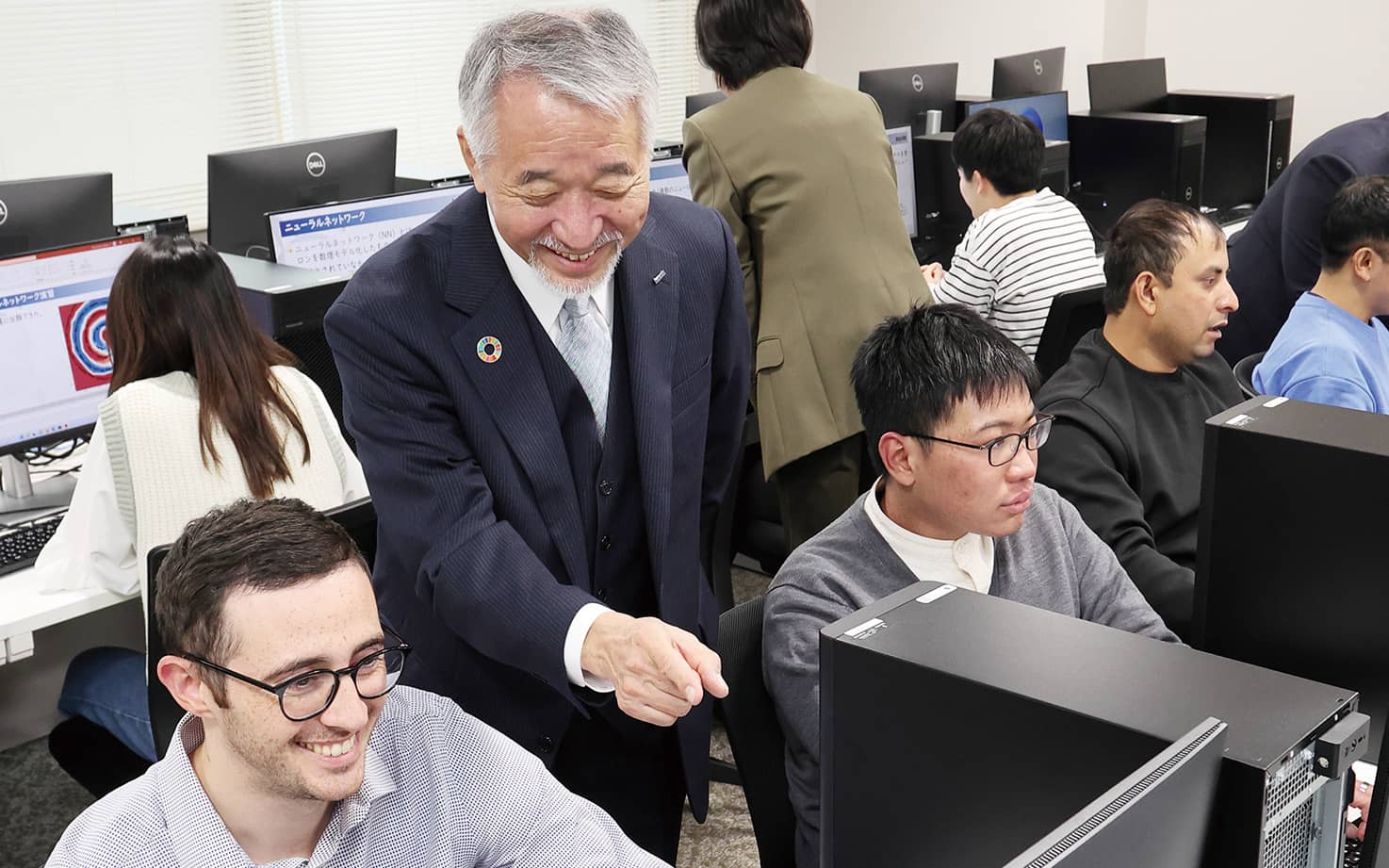
Artificial Intelligence (AI) has been an important field of information science since the mid-20th century. In the 21st century, advances in deep learning, easier access to big data through the Internet, and faster, higher-capacity computer systems have made AI a key technology driving social transformation. AI applications span a wide range of fields, with core technologies such as natural language processing, speech and image recognition, search, and reasoning being applied to machine translation, automated transcription, facial recognition, autonomous driving, medical information processing, care robots, games, and esports. AI is also playing an active role in business strategy, web-based businesses, agricultural management, financial engineering, and other areas, including the development of new businesses and text mining to extract useful information from large volumes of unstructured documents.
In KCGI’s AI specialization, students gain an in-depth understanding of the fundamental theories of AI and data science and learn through real-world examples how these technologies are applied in various fields.Students gain proficiency in a wide range of AI-related software and aim to become professionals capable of effectively applying AI technologies.KCGI also focuses on developing highly skilled engineers capable of developing AI application software, preparing professionals who can contribute to future social transformation.
Target Career Paths
- Professionals with a Strong Foundation in AI Theory and Applied Technologies, Ready to Succeed in an AI-Driven Society
- Professionals Capable of Developing Large-Scale Python Programs and Effectively Using AI-Related Software
- Advanced Engineers Capable of Developing Innovative AI Applications for Pattern Recognition (Images, Speech, Language, etc.) and Business
Themes of past Master Projects
- Histopathological cancer detection using optimised lightweight CNNs.
- Proposal of a No-Reference Objective Image Quality Assessment Method Using CNNs
- Data Lakehouse Architecture for Managing and Analyzing Diverse School Data
- Momentum-Based Contrastive Learning Framework for Scientific Information Verification
- Proposal of a Method for Supporting Exam Question Generation Using ChatGPT and Linked Open Data
- Proposal of an Image Classification Method for Kampo Crude Drugs Using Deep Learning
Message from Project Instructor
Professor, Masaharu Imai
To achieve Industry 4.0 and Society 5.0 and build a human-centered society, three technologies are essential: artificial intelligence (AI), the Internet of Things (IoT), and big data analytics.In particular, artificial intelligence (deep learning), represented by technologies such as ChatGPT, is playing an increasingly important role as an assistant to people in both business and everyday life.I hope that students will develop the ability to make effective use of AI to solve a wide range of problems, as well as the skills to develop applications using AI technologies.
Message from Project Instructor
Professor Hisaya Tanaka
AI technology is advancing exponentially every day, and its applications are expanding across a wide range of fields.In the field of education, AI is improving the quality of learning through personalized instruction, automated translation, and the generation of learning content.In the medical field, AI is being used for diagnostic support, drug discovery simulations, and patient data analysis, enabling more accurate healthcare.In the business sector, AI is helping improve operational efficiency through market analysis, advertising content generation, and automated customer service.In the creative fields, AI has made it possible to generate text, images, music, and video, opening up new possibilities for creative expression.In science and technology, faster simulation and data analysis are accelerating technological innovation.AI can also help eliminate traditional boundaries and barriers across countries, languages, companies, and between people with and without disabilities.I encourage students to take on a wide range of AI application projects, from improving everyday life to cutting-edge research and development.
Examples of courses for different levels of learners
[Semester 1]
Acquire Fundamental Knowledge and Skills for Applying AI
Computer Programming (Python)
Python is one of the most widely used programming languages in fields such as artificial intelligence (AI), the Internet of Things (IoT), and big data analytics.In this course, students learn the fundamentals of Python and essential programming techniques.Through hands-on exercises, students also develop the skills needed to create practical programs used in fields such as artificial intelligence and data science.Improving programming skills also helps develop the ability to solve a wide range of real-world problems.
Fundamentals of Artificial Intelligence
This course provides an introduction to understanding what artificial intelligence (AI) is.Students comprehensively study topics such as the definition of AI, the history of AI research, fundamental AI theories including machine learning, current challenges in AI, and the use and ethics of AI, providing a foundation for understanding more advanced courses.
[Semester 2]
Study AI Theory and the Practical Application of AI Using Application Software
Machine Learning
Students learn fundamental technologies for implementing machine learning (ML), a core area of artificial intelligence, including: (1) concept formation models that simulate the human process of concept formation, (2) multilayer neural networks that simulate information processing in networks of neurons, and (3) evolutionary computation methods inspired by biological evolution.The course aims to develop students’ ability to build optimal classification models using the ML methods described above, as well as their ability to implement these methods in Python using libraries such as Keras and scikit-learn.
Data Mining
Data mining (DM) is a technology for classifying and organizing vast amounts of complex information and data from various fields, uncovering hidden patterns, and discovering useful knowledge that can benefit society.This course introduces a variety of data mining (DM) methods and related algorithms, as well as their suitability and applications. Students learn to identify and use appropriate tools and techniques for mining data in various formats.
Combinatorial Optimization
An optimization problem is a problem of finding a solution that minimizes an objective function under given constraints.This course focuses particularly on combinatorial optimization problems. Students learn examples of combinatorial optimization problems, how to formulate specific problems as mixed-integer programming problems, and algorithms for representative network optimization problems such as the shortest path problem, maximum flow problem, and traveling salesman problem.
AI Software Applications I
In recent years, artificial intelligence (AI) technology has made remarkable advances in what is often referred to as the third AI boom, leading to the active development of AI application systems using new AI technologies across a wide range of fields.In this course, students learn about machine learning, a key technology in artificial intelligence (AI).Using Python libraries, students run representative machine learning methods on their own computers to understand how they work and develop practical AI application skills that can be applied to a variety of data analysis tasks.
[Semesters 3 and 4]
Study Practical AI Applications and Application Development
Robots and Artificial Intelligence
Robots were originally developed primarily for industrial applications, but today, with the integration of artificial intelligence (AI), they are widely used in a broad range of areas, including homes, healthcare and nursing care, security, warehouse management, reception services, and routine office tasks through Robotic Process Automation (RPA).In this course, students view robots as agents and study models of agent intelligence. They then learn about the basic structure and core technologies of robots, followed by examples of robotic applications in various fields.
Natural Language Processing (NLP)
Natural language processing (NLP), along with image understanding (pattern recognition) and speech recognition, has a long history as one of the core technologies of artificial intelligence, with extensive research and development conducted over the years.Representative applications of natural language processing include machine translation, automatic summarization, transcription, and chatbots.This course introduces a range of fundamental technologies and the latest deep learning techniques for natural language understanding and its applications, while also discussing future research challenges.
Games and Artificial Intelligence
Advances in artificial intelligence have led to the development of AlphaGo, which shocked the world by defeating a top professional Go player, and AlphaZero, which generalized this approach so that it could also be applied to games such as chess and shogi.In this course, students learn technologies used in these computer games, including deep learning, Monte Carlo Tree Search, and reinforcement learning.Students also learn how to create human-like behavior in characters, which is essential for achieving greater realism in real-time interactive content.
Speech Comprehension
This course introduces the fundamental concepts of signal processing and artificial intelligence that underpin the latest speech recognition applications, and explains how to develop original speech recognition applications. The fundamental concepts introduced include waveform segmentation and labeling, sampling frequency, frequency-domain analysis, spectrograms, and Mel spectrograms. Using open-source speech recognition and speech synthesis toolkits, students learn how to create voice-controlled web browsers and personal assistants.
Our presentation at the "ITU AI/ML in 5G Challenge" competition won the best domestic award.
A team of faculty members and students from our university who participated in the "ITU AI/ML in 5G Challenge" competition (held on November 11, 2020), which aims to solve real-world problems by applying machine learning to communication networks, made presentations at the competition and were selected as one of the top three teams in Japan and won the Grand Prize.Our team selected "Estimation of Network State by Video Analysis in Real-time Streaming Service" from the three themes presented by the competition, and estimated the network state (throughput and loss rate) by using machine learning in real time.This is a timely theme that can contribute to solving problems unique to modern society, which is experiencing extreme congestion as a result of the rapid increase in the use of Zoom and other webcam-based telework systems due to the global spread of the new coronavirus.Nowadays, computer networks are the lifeline of society, and this presentation proposes one of the ways to apply machine learning to future networks.This model has the potential to improve communication speed, communication delay, and the communication system itself, and is expected to be used in the future.