Acquire and develop practical skills useful for society
Curriculum design in response to the needs of the IT industry and the evolution of IT
In order to promote education that meets the needs of industry, The Kyoto College of Graduate Studies for Informatics develops curriculum, course design, and instructional design with the advice of experts both inside and outside the organization. In addition, in order to respond to the rapid changes in IT (ICT), we are importing and jointly developing the latest IT education curriculum in cooperation with Rochester Institute of Technology in the United States.
Development of education based on the world's most advanced educational theories
Since the mid-1990s, when the Internet became widespread and online distance learning appeared in the United States, there have been many surveys and studies on the differences in educational effectiveness between e-learning and face-to-face classes.Research has shown that for highly motivated learners, the difference between online and face-to-face is merely a difference in the means of communication and does not change the educational effect. Wataru Hasegawa, a professor at this university, has experience participating in advanced research on e-learning implementation; for example, while studying at Columbia University’s Graduate School in the United States—a world-leading institution in the field of education—he was selected as one of the few members of a project team tasked with exploring the establishment of a new e-learning department for 800 students.Our education, both online and face-to-face, is designed and operated based on the world's most advanced and cutting-edge educational theories.
Comprehensive and Practical Curriculum Structure
In order to develop human resources with IT (ICT) and management skills, The Kyoto College of Graduate Studies for Informatics considers allowing students to take not only IT-related courses but also many business-related courses, such as those related to management and economics. In their graduation year, students acquire advanced skills to plan and execute a Master Project, as an alternative to the typical master's thesis at a conventional graduate school, to establish their career.
Adoption of an effective educational method by combining e-learning and face-to-face teaching
Since its founding, the university has implemented state-of-the-art e-learning systems and has been conducting real-time online lectures connecting the main campus in Kyoto with its satellite campuses in Sapporo, Tokyo, and Athens (Greece)—which were established subsequently—as well as with universities overseas.We possess cutting-edge expertise and a long track record in online instruction, and our courses are designed to deliver results equivalent to those of traditional in-person classes.
Currently, we offer four formats: (1) traditional in-person classes held in classrooms; (2) hybrid classes, in which the instructor teaches either in person or remotely, while students can choose to attend from the classroom or from any location outside the classroom, such as their homes; ③ synchronous (real-time online) classes that enable interactive communication using online conferencing tools and e-learning systems, and ④ on-demand, asynchronous classes where students view course content within a specified period. We have established a system that allows students to attend classes without being constrained by location or the tools they use.
Both now and in the future—even under circumstances such as a pandemic caused by various infectious diseases—students will be able to choose their preferred format of instruction and continue to deepen their learning in a safe and secure environment.
*Students with Chinese citizenship must attend classes in person in order to have their academic credentials certified in China.
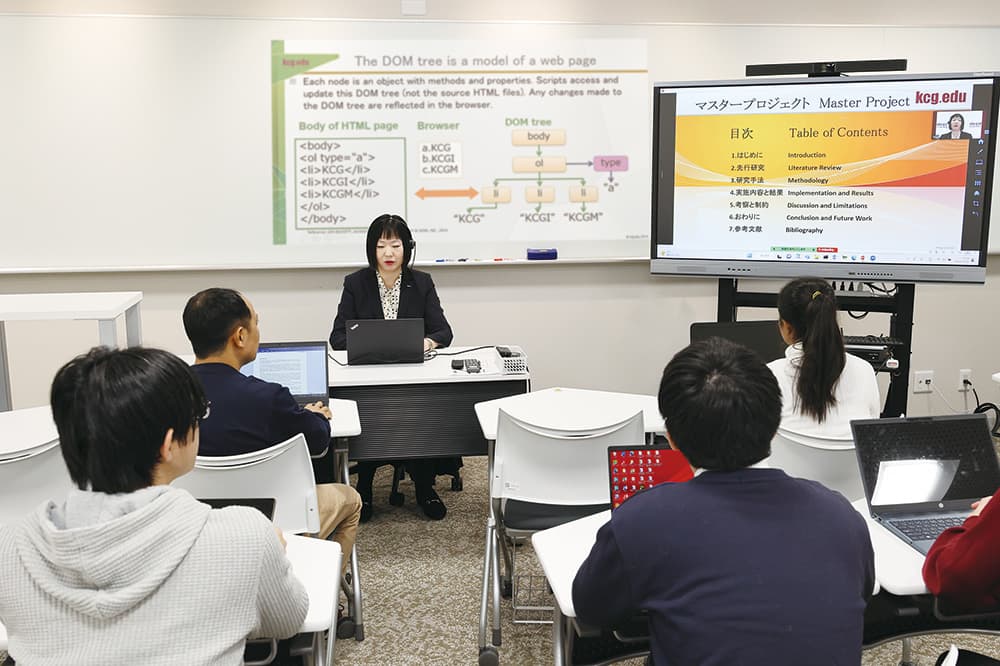
Learn about IT (ICT), business management, and the practical application of these fields across various industries
We aim to train professionals in multiple specialized fields, including information and management
In today's business scene, there is a need for human resources who have both IT (ICT) skills based on web technology and management skills such as business strategy formulation. At the Kyoto College of Graduate Studies for Informatics, we train professionals in several specialized fields, including information and management. The curriculum is designed to provide students with a good balance of information and management courses according to their individual backgrounds.
Addressing IT (ICT) as it is applied across all fields through “Specialized Fields” and “Industry-Specific Courses”
To help students acquire specialized and broad knowledge in specific areas within the broad field of IT, our university has established nine specialized fields: ● Artificial Intelligence ● Data Science ● Web System Development ● Network and Security Management ● Global Entrepreneurship ● ERP ● IT Manga and Anime ● IT Tourism ● IT Entertainment.
In addition, to cultivate professionals who can apply IT (ICT) and excel in fields such as finance, agriculture, marine sciences, healthcare, and education, we have established an industry-focused course cluster and offer courses in these areas.
We aim to develop human resources who can provide solutions needed in each field by developing knowledge and skills in all fields in a thorough, practical curriculum.
We recruit many teachers with practical experience in IT strategy planning for companies
At the Kyoto College of Graduate Studies for Informatics, we have many faculty members in practical fields, including those who have served as CIOs in companies. Each faculty member fosters the practical skills of students through classes based on their own practical experience.Students acquire comprehensive professional skills while deepening their understanding of the latest theories and technologies directly linked to practical work.
Make a career change and work in the IT field.
It is possible to advance from a wide range of fields regardless of liberal arts or science.
The goal of The Kyoto College of Graduate Studies for Informatics is to develop human resources with diverse backgrounds as highly specialized professionals in the IT field. In recruiting students, there are no restrictions on previous study majors, and a wide variety of students are accepted from a wide range of fields, including liberal arts and science. Elective courses tailored to the knowledge, skills, and needs of students with a wide range of backgrounds are available. We also support a variety of courses for working students. The Kyoto College of Graduate Studies for Informatics has created "career change opportunity" that Japanese graduate schools have not been able to provide sufficiently.
Students can take courses according to their level of knowledge at the time of admission.
At this university, students of various IT skill levels are studying, from those who have little knowledge of computers to those who have graduated from the Faculty of Arts and Sciences, to working adults who are active in the IT industry as SEs.Our university provides each student with a course pathway (recommended course sequence) tailored to their IT skills and future goals.This makes it easy for students without prior knowledge to reach their goals in stages. While a master's degree can be obtained with 32 credits from a typical graduate school, The Kyoto College of Graduate Studies for Informatics offers a master's degree with 44 credits, which is 12 more credits. The purpose of this is for students to not only acquire and strengthen IT skills and knowledge, but also to develop human resources who can apply them practically by acquiring deep and broad specialized knowledge in their chosen fields in order to meet the needs of diverse industries.Our university offers a diverse range of learning options with a high degree of flexibility through a combination of “specialized fields” and “industry-related courses.”In addition, the Master of Information Technology (professional) awarded by the University is called a terminal degree because there is no higher degree.This means it is the highest degree in ICT applications. If a student wishes to pursue a higher degree (Ph.D.), even if the field of study for that higher degree is different, the diversity of study at this university will be helpful in the future.
Strive to achieve global success
Classes by leading experts in the IT field from around the world
The IT business is a field that expands globally across borders. In order to help students, acquire an international perspective, The Kyoto College of Graduate Studies for Informatics invites top quality teachers from various regions, including Europe, the United States, and Asia. Athens Satellite established in Greece as the KCGI European base.In addition, we have entered into academic exchange agreements and business partnerships with universities and companies around the world—including the Rochester Institute of Technology and Columbia University in the United States, as well as the Graduate School of Information Security at Korea University in South Korea, which is recognized as one of the world’s leading institutions in the field of information security—and are actively promoting global exchange through joint research projects and international symposia.
Study abroad and Overseas Classes
We are affiliated with many universities in many countries, including the Rochester Institute of Technology in the United States. You can try to study at an affiliated school or present at an international conference. In addition, students have the opportunity to participate in classes offered at overseas partner schools as a TA, and can also take advantage of the overseas internship system.
We hope students can take advantage of what is learned to play an active role in society
Achieving ideal employment through Individual guidance
We aim to realize employment for all students at the time of completion. The faculty member in charge will make use of his experience and personal connections in the industrial world, etc., and make recommendations to companies through individual interviews with students in order to realize the ideal employment.For students who wish to start a business, we will provide various support such as teaching them how to set up a company and how to manage it.
Building a business network among graduates
Our school has a variety of graduates with IT as their common interest, and we are focusing on building a business network among graduates. By providing opportunities for group work while still in school, we aim to enable alumni to make use of their respective skills and develop business while cooperating with each other even after graduating and entering society.
With a robust curriculum delivered in “English Mode,” we cultivate the “globally-minded professionals” sought by the industry.
Our university offers a wide range of courses in the “English Mode” so that students can complete the university’s program and earn a master’s degree by taking only courses taught in English.These lectures also include those taught by top-tier faculty members invited from overseas.Our university currently has international students from 15 countries and regions, and many of them choose to take courses taught in English.This is one of the university’s major strengths.
On the other hand, even Japanese students can take classes taught in English if their English proficiency meets the required level.By taking full advantage of the international environment our university offers, you can not only further improve your English skills while studying IT, but also develop an international perspective.
In the IT industry, it is essential to stay up to date with the latest information.If you can apply this useful information to your development and production work, it will lead to significant growth in your career within the industry.Since new technologies are constantly emerging in the IT industry, the ability to stay up to date with the latest information is extremely important.In many cases, the latest technologies and products make their way into Japan from overseas—such as the United States—and most of the information about them is written in English.Since there are far more engineers for whom English is their official language than in Japan, high-quality information and articles are inevitably written in English more often.There’s no doubt that being able to quickly catch up on English-language information necessary for your work and professional development will give you an advantage in your career.In particular, if you are aiming for a position at a foreign-affiliated IT company or a top-tier career in the foreign IT consulting industry, making the most of our university’s signature “English Mode” program can be highly effective.
Comments from a Faculty Member Teaching an English-Language Course: Professor Izu Matsuo
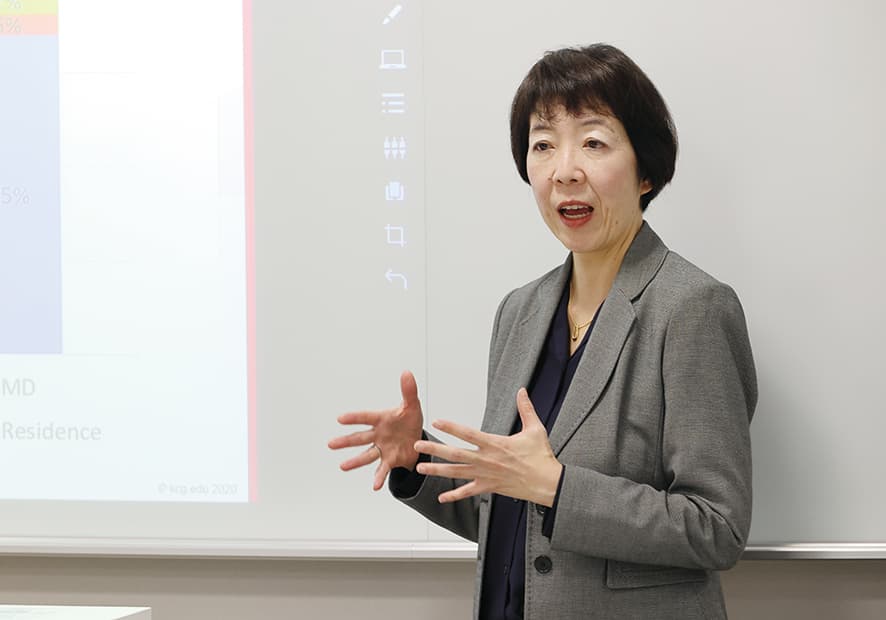
As technology and socioeconomic conditions around the world continue to change day by day, fostering globally-minded individuals has become increasingly important in university education. As the demand for English proficiency, expertise, and the ability to think from an international perspective continues to grow, I hope you will approach your studies and actions with curiosity and enthusiasm.
I myself have lived abroad since childhood and have received my education and built my career in both Japan and the United States.In the business world, I have specialized in sales and marketing at manufacturers and global IT companies.Based on that experience, our university offers business-related courses in English from a global perspective, with a focus on practical application.In addition, we design our curriculum to include team projects and presentation opportunities so that students from around the world can deepen their learning together.
At Kyoto University of Information Science, a variety of courses are offered in both English and Japanese to help students acquire cutting-edge specialized knowledge, and students can also take classes to prepare for certification exams recognized by companies around the world.I hope that all of you, as future leaders, will spend two fulfilling years here in Kyoto—a city that attracts international attention—building friendships with faculty members from a wide range of disciplines and students from all over the world.
Widen the range of possibilities
We participate in global content-related events.
In addition to exhibiting at “Japan Expo,” a comprehensive exposition of Japanese culture held in France, we also co-host the “Kyoto International Manga and Anime Fair (Kyomaf),” a comprehensive trade show for manga and anime.
I serve as the secretary for the Kyoto Association for Manga and Anime Studies.
We have established academic societies in various genres related to IT (ICT) and are working on research and development activities and networking.
As the administrator and operator of the new top-level domain ". Kyoto", which represents "Kyoto", we transmit the Kyoto brand to the world.
With the support of Kyoto Prefecture and approval from the worldwide domain management organization, we are the only educational institution in the world to manage top-level domains with geographical names.
If you have high-level IT skills, the average annual salary is over 9.37 million yen.
Levels 4 and 5, classified as “High Level” in the IPA IT Skills Standard V3, are defined as “individuals who have established themselves as professionals in a specialized field and are able to apply their knowledge and practical skills to the training of the next generation.”According to the “Survey Results on Salaries in the IT Industry” released by the Ministry of Economy, Trade and Industry in August 2017, the average annual salary for Level 5 employees exceeds 9.37 million yen.In order to realize such a career advancement, it is not only a matter of gaining work experience in a company, but also a powerful option to learn practically about the area of business and IT at a professional graduate school of IT like ours.