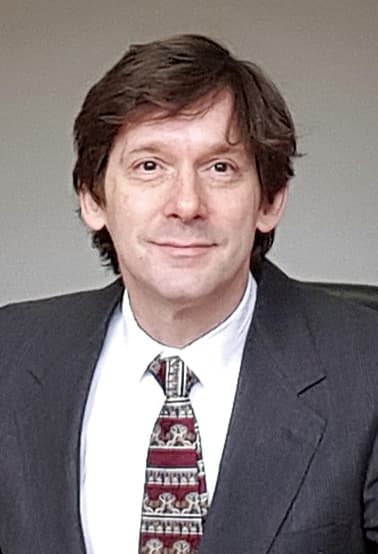
Mark Hasegawa Johnson

Mark Hasegawa-Johnson

Profile

  • Massachusetts Institute of Technology (U.S.)—Bachelor of Science; Master of Science; Ph.D. in Electrical and Computer Engineering
  • Professor, University of Illinois (U.S.); Researcher, Advanced Digital Science Center (Singapore)
  • Selected for the 2025 Forbes Accessibility 100 and the 2026 Forbes Accessibility 200

Message

We have driven this world for 1000 years with the power of information strings stretched from person to person. Human beings are said to be speaking animals and differ from other organisms in their ability to transmit complex information.

For example, if you do farming, you need information and knowledge. It is impossible to grow rice without knowledge. Architecture is also nothing but information. If you design a building with more than two stories without knowledge, it will collapse from where it is built. Basic science is the search for knowledge and information; engineering is the study to commercialize information; and commerce is the business to monetize information.

Information science (Informatics) is the study of information. Information science is the study of how to organize expertise systematically in all other disciplines, how to communicate the most important knowledge to each other, and how to find the information we need to address new challenges. The development of information science enables the development of agriculture, architecture, science, engineering, and commerce. Furthermore, progress in information science itself will accelerate and expand its development. Until the 20 century, information networks, "strung like a spider's thread", were merely metaphors, and most of the information threads were made of paper and ink. In the 21st century, the thread of information became lighter than the actual spider thread, faster than the crack in the ice of the pond, and stronger than the root of an oak tree. It takes almost no time, if not more, to communicate a new idea to a friend far across the world sooner than you can think of it. As a result, we are suddenly unable to keep up with sheer amount of information, which is the subject of information science, and fall behind. The amount of information that flows around the world every day has become so vast that it has become difficult for a small number of information science professionals to understand, relate, and organize it all. As the amount of information that people exchange increases exponentially, we have invented machines to process information. However, these devices themselves generated more information, and the increase in the amount of information further progressed.

The exponential growth of this information is both very difficult and a great opportunity. Providing people with information science education, creating the artificial intelligence needed to manage the flow of information, and teaching artificial intelligence are difficult challenges. I call it a great opportunity in the sense that opportunities in all fields are opportunities for information science; since information is essential for all human activities. Information Science is responsible for agriculture, architecture, science, engineering, and commerce, and we are responsible for information science.

Responsible Subject

  • Speech Comprehension
  • Master Project 6

Field of Specialization

  • Professor Hasegawa-Johnson is an expert in speech and natural language processing. More broadly, he tracks and reports on developments in all fields of artificial intelligence

Achievements

Professor Hasegawa-Johnson is author co-author of 58 published journal articles and book chapters, 188 peer-reviewed conference and workshop papers, and 50 published abstracts.

His most heavily cited publications according to google scholar are: