Summary
An aluminum sphere less than 60 cm in diameter orbited the Earth, becoming Sputnik 1, the world’s first artificial satellite.Nearly 70 years have passed since then, and today, more than 10,000 artificial satellites are in operation.As the saying goes, “Earth is humanity’s cradle, but humanity will not remain in the cradle forever.” Space has become a familiar subject in our lives.The terms “space industry” and “space business,” which encompass everything from the manufacture and launch of rockets and satellites to space-based services such as satellite communications, positioning, and Earth observation, have also become familiar to us. We benefit from these developments every day, and they are becoming increasingly relevant to our daily lives.We are entering an era in which, based on space science, we view space as natural capital and expand its utilization to improve quality of life.
Kyoto Computer Gakuin (KCG), the parent institute of KCGI, began with the FORTRAN Research Group, founded in 1963 by Yasuko Hasegawa, the first female student in Kyoto University’s Department of Astronomy. She used computers to perform scientific and technical calculations.From the start, young researchers from the department participated in the research group, which eventually developed into KCG and then KCGI.With roots at Kyoto University’s Department of Astronomy spanning more than 60 years, the Space Science IT concentration offers an environment for exploring the frontiers of space.Through a curriculum that emphasizes practical application, including the effective use of vast amounts of satellite data, students will gain a scientific understanding of space and acquire fundamental knowledge and skills in space science and engineering.
What You’ll Learn?
- Fundamentals of Space Science
- Fundamental Technologies and Knowledge for Space and Earth Exploration
- Utilization of Satellite Data
- Global Environmental Conservation and Disaster Preparedness
- Solar Activity and Space Weather
- Future of Space Development
- Fundamental Applied Information Technology
Career Paths
- Space-related Systems Developer
- Space Industry Engineer
- Practical Applications of Satellite Data
- Disaster Preparedness in Public and Private Sectors
- Meteorologist/Space Weather Forecaster
- Active in space-related businesses
- etc
Message from Project Instructor
Professor Seiichiro Aoki
Learn how to use satellite data and gain scientific knowledge.
In addition to state-led space development efforts by China, Japan, India, and others, including the U.S.-led Artemis Program, the private sector is also actively pursuing initiatives such as rocket development and the utilization of data acquired from satellites.As a result, the space market is expanding, and the demand for skilled professionals continues to grow.Against this backdrop, the Space Science IT concentration allows students to build a foundation in IT, a key component technology in space development, while learning practical methods for utilizing satellite data and other data. Students can also acquire the scientific knowledge needed to make practical use of these data, including topics such as “space weather,” the environment between the Earth and the Sun, and “solar activity,” which can affect conditions in this environment.Build your IT foundation with knowledge and skills in science and engineering, and pave your way towards a future career in space science.
Message from Project Instructor
Professor Sonoyo Mukai
Acquire IT skills while studying space and Earth sciences.
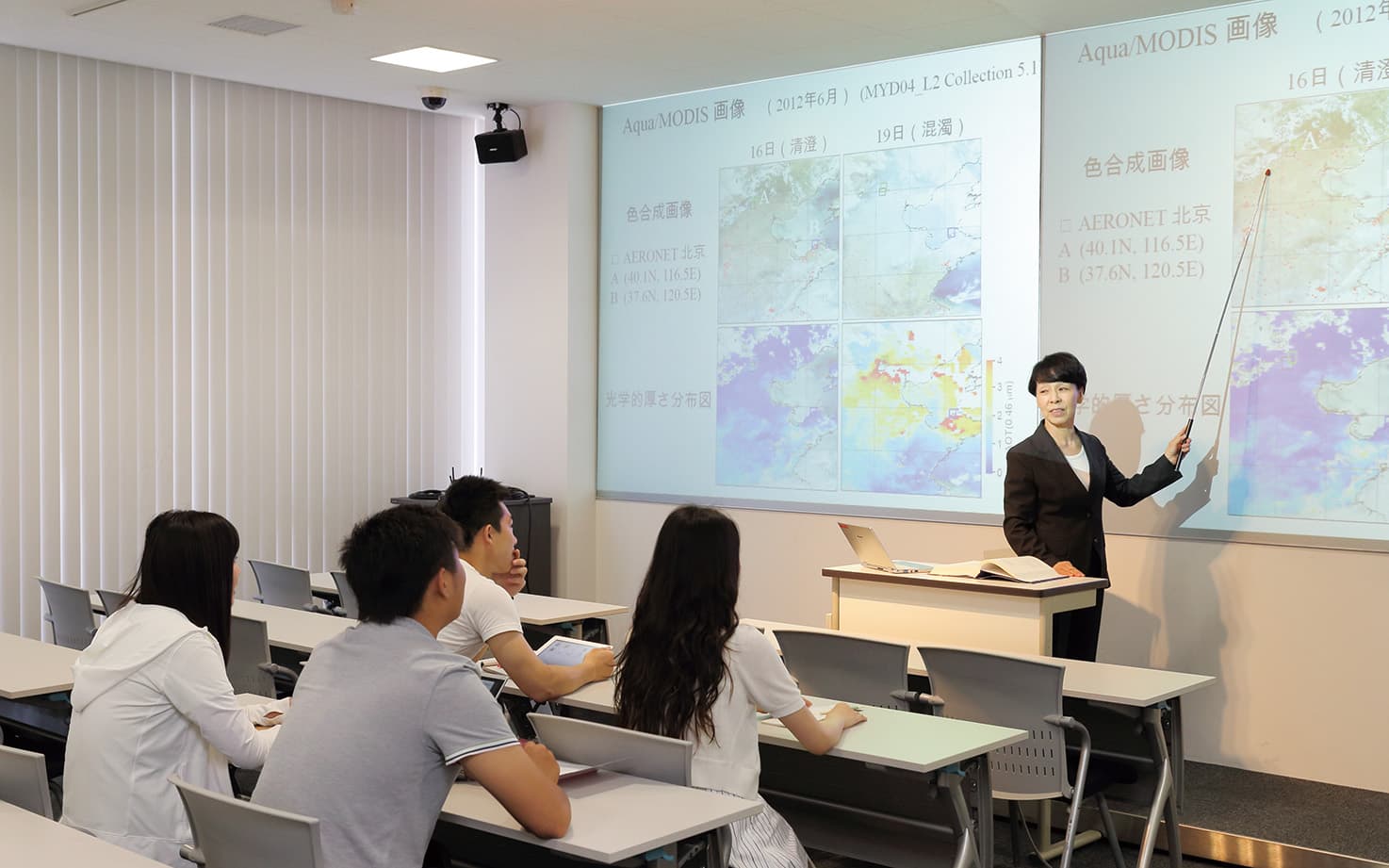
Many years have passed since the words, “The Earth was blue” inspired people around the world and the dream of seeing the Earth from space became a reality. Today, satellite data on Earth’s environment and weather have become an everyday part of our lives.Why not become one of the people who provide this information?Information processing skills are essential for acquiring and accurately processing satellite remote sensing data to help protect global and local environments, as well as to detect and forecast weather-related disasters.Our learning facilities welcome students regardless of prior knowledge or technical background.The Space Science IT (SSIT) concentration allows you to acquire and hone your IT skills while studying space science and Earth science!
Course Description
Fundamentals of Space Science
To begin their studies in Space Science IT, students acquire fundamental knowledge of space science that will serve as a foundation for subsequent coursework.The course covers not only celestial bodies within the solar system, the primary focus of Space Science IT, but also topics such as the structure and origins of the universe.
Programming for Satellite Data Processing
As a first step in processing observational data from artificial satellites, students learn about the basic structure of satellite data, data acquisition methods, and the fundamental algorithms required for applied processing through practical programming exercises using Python. Basic concepts of satellite remote sensing will also be explained.
Planetary Science
Planetary science is a relatively new field.From the time when shepherds imagined constellations in the sky to the present day, new discoveries about planetary systems have been made, and new mysteries have emerged.This course focuses on the worlds formed by stars and planets—known as planetary systems—and introduces the history of research in this field, including the latest findings.
Fundamentals of Space Weather
This course covers the mechanisms of space weather driven by solar activity and the effects of solar flares and coronal mass ejections (CMEs) on Earth's magnetosphere and ionosphere.Students will gain a fundamental understanding of the impacts of space weather on satellites, GPS, communications, and social infrastructure such as power grids, as well as observation and analysis methods for space weather forecasting and the challenges and countermeasures associated with future space utilization.
Solar Activity
Students learn about the internal structure of the Sun, energy generation through nuclear fusion, the structure and magnetic field characteristics of the solar atmosphere (photosphere, chromosphere, and corona) under quiet-Sun conditions, and active phenomena such as sunspots, flares, prominences, and the solar wind, based on fundamental physics. Students gain an understanding of the Sun as a fundamental model in stellar physics, acquiring the foundational knowledge necessary to study stars and various astronomical phenomena.