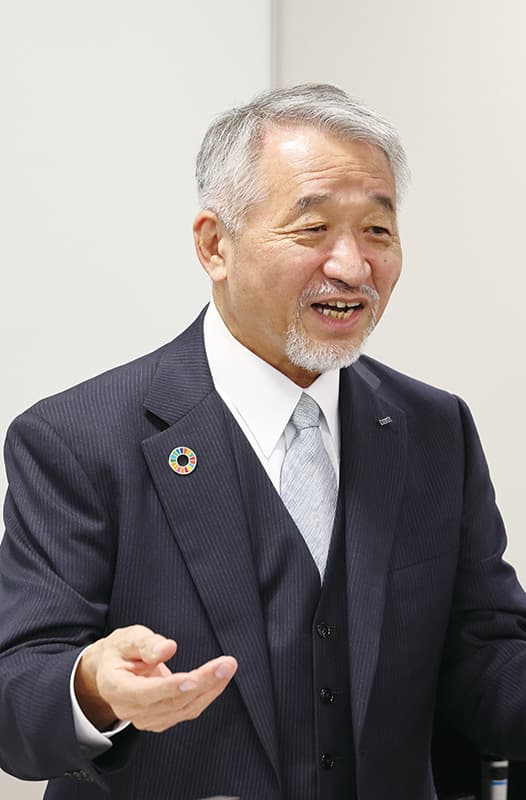
Professor Masaharu Imai
Director, Sustainable Open Innovation Center (SOIC), KCGI
Bachelor of Engineering, Nagoya University
Doctor of Engineering, Nagoya University (Information Engineering)
Former Professor, Toyohashi University of Technology Former Visiting Associate Professor, University of South Carolina, USA
Professor Emeritus, Osaka University
Former Chief Technology Officer and Director, Techson, Inc.
Representative Director, ASIP Solutions, Inc.
Professor Masaharu Imai is developing an educational program that keeps pace with the latest industry trends, with the goal of training engineers capable of building applied artificial intelligence (machine learning) systems while effectively utilizing the Internet of Things (IoT).In recent years, he has taught the course “IoT and Artificial Intelligence,” providing instruction on topics such as the implementation of machine learning in edge computing.He serves as the director of the “Sustainable Open Innovation Center,” which aims to promote collaboration between the university and external organizations—including industry, government agencies, financial institutions, educational and research institutions, and NPOs—and to advance research, development, and demonstration experiments based on the SDGs.
Become a Leader Who Can Build and Manage Organizations That Embrace Diversity and Inclusion
AI Will Indeed Replace Some Jobs—but It Will Also Create More Advanced Roles and New Types of Work
What role will AI play in the Fourth Industrial Revolution?
The Fourth Industrial Revolution is expected to transform industrial structures by connecting a wide range of physical objects to the Internet and using artificial intelligence (AI) to control them.This will bring major changes to people's roles and the way they work. IoT (the Internet of Things) and AI technologies have become essential for operating robots intelligently.
The most significant impact of the Fourth Industrial Revolution is that systems in which people examine computer analyses of information collected over the Internet and make decisions themselves are being transformed into systems capable of making intelligent decisions without human intervention.Furthermore, advances in machine learning, a branch of AI, have made it possible for computers to learn how to make decisions on their own, without being explicitly taught by humans.
Some people fear that AI will take over virtually all human jobs, but I do not share that view.It is true that the Fourth Industrial Revolution will eliminate the need for people to perform certain types of work. At the same time, however, effective use of AI will create opportunities for more advanced work and entirely new occupations.
Understanding the SDGs Means Sharing New Values and Ethical Principles
What do you emphasize in your teaching and lectures?
In education, I place particular importance on developing the ability to understand fundamental principles in depth and apply them to real-world challenges, explain one's ideas clearly to people in other fields, and understand the SDGs (Sustainable Development Goals) as a framework for addressing social challenges.As we face technologies capable of profoundly changing human life, traditional moral standards alone are no longer sufficient. We need to share new values and ethical principles that reflect the kind of development we want to pursue as a society.
Together with several early-career faculty members, I established a seminar called Open Innovation Seminar (Oz) to support students undertaking Master’s Projects. In this seminar, students are expected to explain their research to people from other disciplines.I support students in achieving their goals by helping them develop not only technical skills but also the ability to foster diversity and inclusion.
Develop the Insight to Distinguish Fact from Fiction in AI-Generated Answers
What goals would you like KCGI students to pursue in their studies?
Among recent developments in AI, generative AI systems such as ChatGPT have attracted the most attention.Generative AI can serve as an excellent personal assistant, and using it effectively can greatly improve the productivity of intellectual work.However, one problem is that its answers are not always correct.For example, when ChatGPT first became widely available, I asked it, “Who is Masaharu Imai?”ChatGPT replied with great confidence,“He is a Japanese musician, composer, arranger, keyboardist, and music producer.” It went on to say that he was primarily active in the worlds of animation and video games.This was completely false.If we accept AI-generated answers without question, we risk becoming subservient to the technology rather than using it as a tool.
At KCGI, we place great importance on the concept of STEAM education, which adds Arts and the liberal arts to STEM: Science, Technology, Engineering, and Mathematics.Through this educational approach, I hope students will develop the knowledge, judgment, and intuition needed to evaluate AI-generated answers critically rather than believe them unquestioningly.I believe humanity's goal in the 21st century should be to address the many social challenges we face today, including global warming, poverty, and inequality, and to create a sustainable society in which people can live happy lives.IoT and AI will play a powerful role in achieving this goal.We are living at a major turning point in both technology and society.I hope that, in the future, students will use the knowledge, skills, and ways of thinking they acquire at KCGI to make meaningful contributions to society in their respective fields.