Although The Kyoto College of Graduate Studies for Informatics is a professional graduate school dedicated to training highly specialized professionals, it also hosts a vibrant research community.A large number of researchers—including not only academic scholars but also professionals from the corporate sector—are engaged in applied information technology research. Here, we introduce some of these projects.
On October 30, 2025, The Kyoto College of Graduate Studies for Informatics and Kyoto Computer Gakuin signed a collaboration agreement with Kyoto University’s Center for Field Science Education and Research (Field Science Center) aimed at integrating the fields of IT and field science.The purpose of this project is to contribute to the development of education, research, and social cooperation activities by promoting the application of information and communication technology in cooperation and collaboration with each other in the academic field of the Connectivity of Hills, Humans and Oceans proposed by the Field Science Institute.
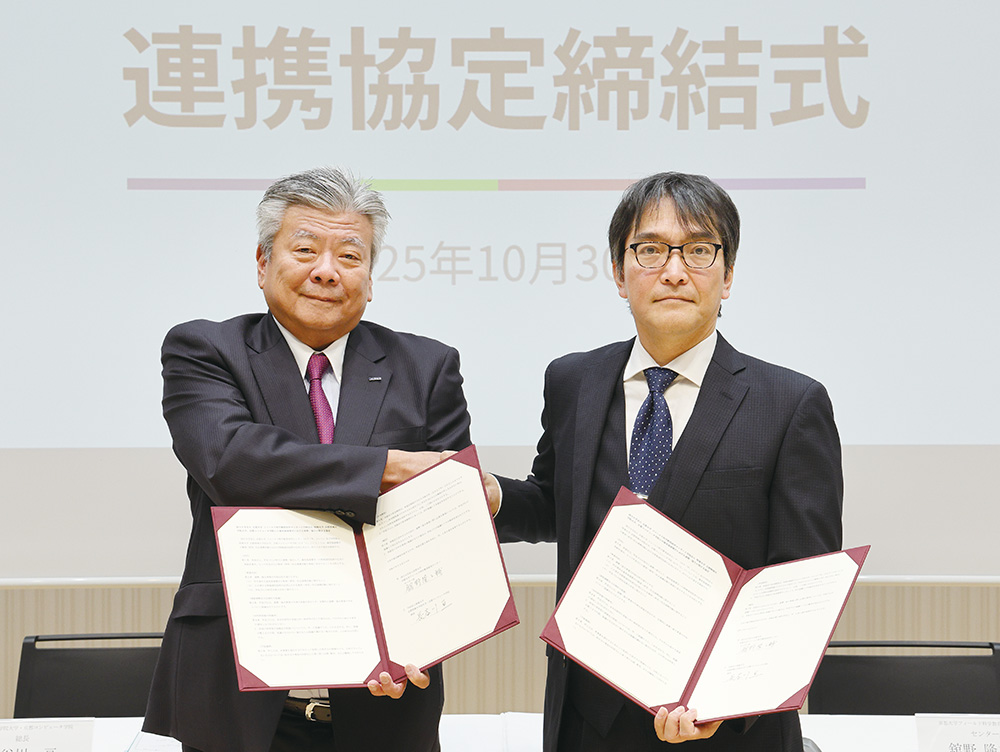
At the signing ceremony, Ryunosuke Tateno, Director of the Field Research Center, explained that IT is essential in various aspects of research, including field surveys, automated observations, management of survey sites and specimens, and data analysis.He expressed his hope that they could work together to explore future possibilities for utilizing IT, such as helping students reflect on their learning, motivating them for fieldwork, and fostering connections between people.KCGI and KCG President Hasegawa remarked in his address that linking the Field Research Center’s needs with the learning experiences of KCGI and KCG students could lead to an exciting collaboration that leverages both parties’ strengths.
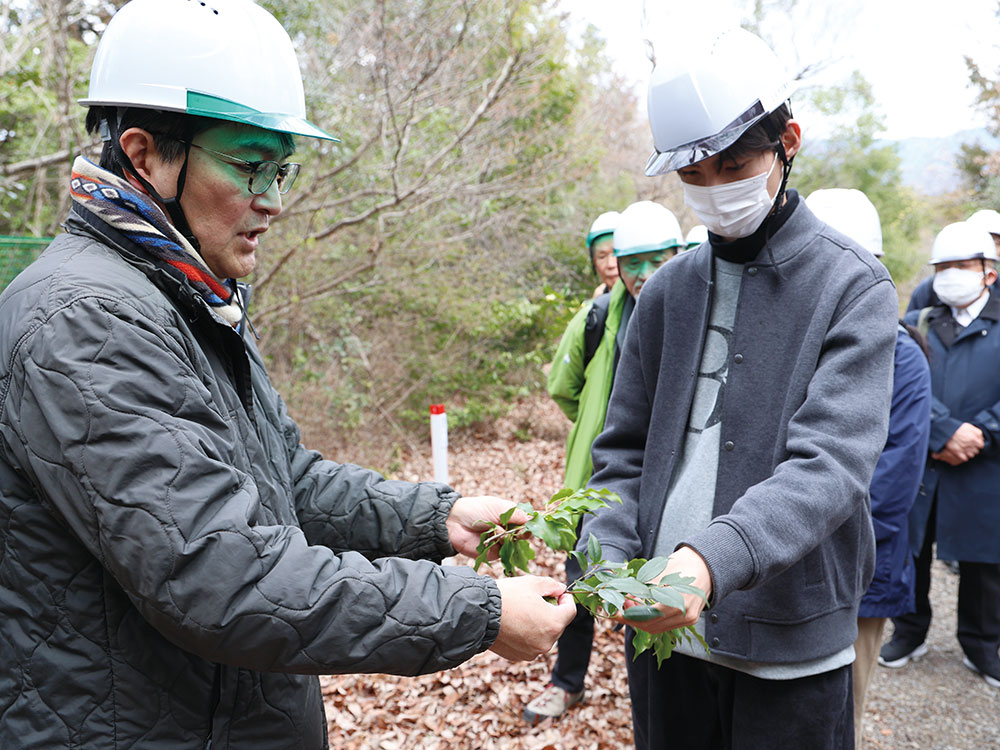
On March 23, 2026, students and faculty members from KCGI and KCG visited the Field Research Institute’s Kamigamo Experimental Site as part of a collaborative course with the Field Research Institute, where they learned about on-site observations and research activities.After receiving an explanation from Center Director Tateno and Kamigamo Experimental Site Manager Nao Sakanoe regarding the site’s history and initiatives, the group toured the herbarium, which houses approximately 10,000 specimens—including trees and seeds—collected from various research forests.In the field, while learning about the types of plants present and how they are managed, they considered how information technology could be utilized.Even students who typically spend much of their time in front of computers were able to develop new ideas as they walked through the field. During the lecture, building on their field experience, the students deepened their understanding of the importance of integrating detailed vegetation observations from the ground with wide-area observations from satellites.
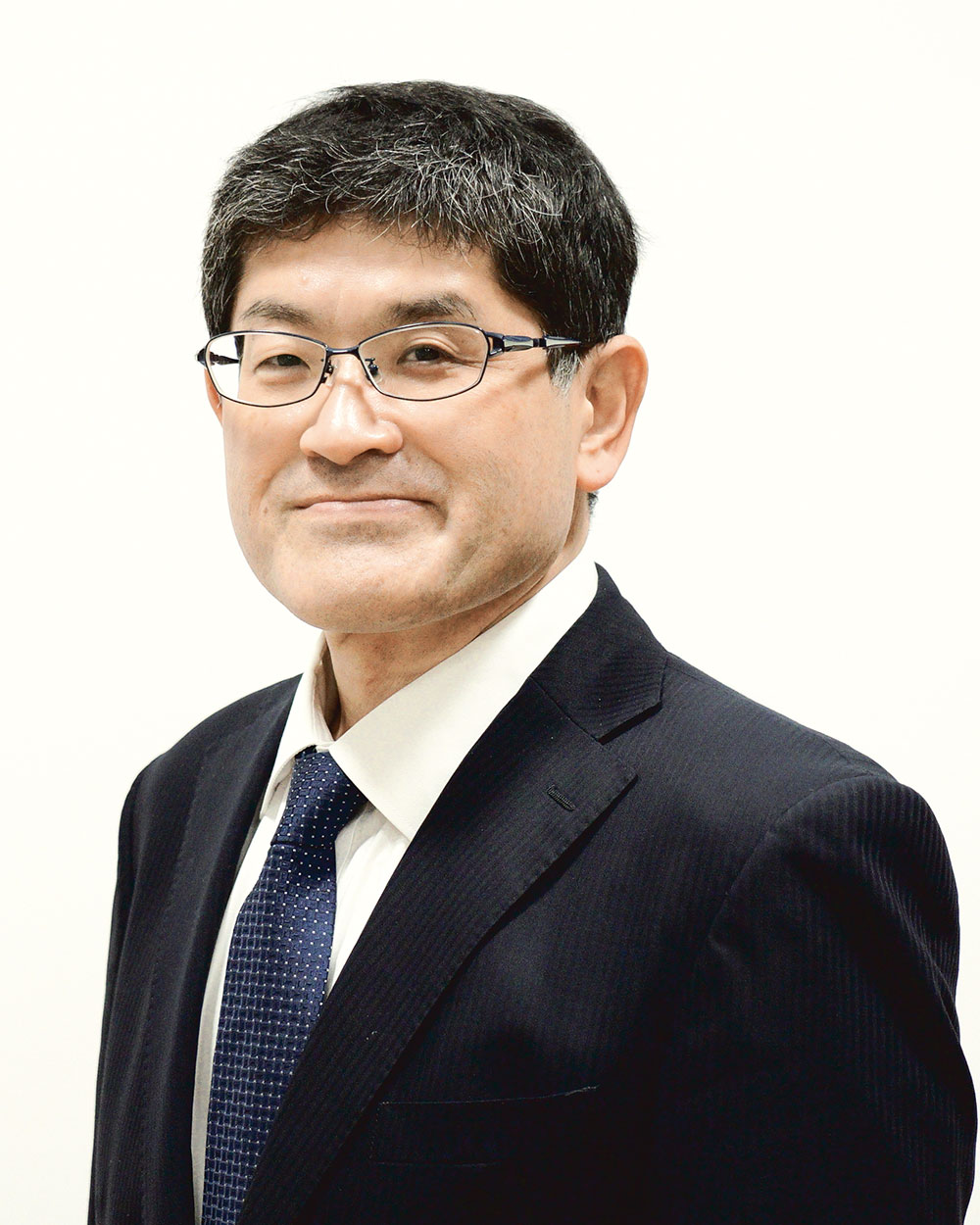
Professor Seiichiro Aoki
I earned a Ph.D. in Science from the Graduate School of Science at the University of Tokyo for my theoretical research on phenomena surrounding black holes.We have expanded our research activities to include astronomy education and outreach. In addition to giving lectures using stereoscopic astronomy videos and organizing the “Kyoto Millennium Astronomy Trail”—a historical astronomy walking tour in Kyoto that we began in 2011 in collaboration with Professor Sakka of our university—we are also conducting text analysis of the open-ended comments provided by participants in survey responses.We are also conducting the “Forest Where You Can See the Stars Project” with high school students in Gifu Prefecture to preserve and utilize satoyama landscapes.
The research themes that our university prioritizes are instructional design that promotes self-directed learning—based on the ICE approach introduced by Professor Tsuchimochi from Canada—and the tracking of educational progress.I am conducting research on this topic as the principal investigator under the Grant-in-Aid for Scientific Research (KAKENHI) program.In the ICE approach, the learning process is divided into three stages—I (Ideas), C (Connections), and E (Extensions)—and it is believed that learning progresses in a cycle of I → C → E → I → ... This research views the transfer from I to C or E as a manifestation of self-directed learning and aims to develop lesson designs that promote such transfer.We are currently working on fine-tuning BERT—a general-purpose natural language model based on the Transformer architecture, which serves as the foundation for ChatGPT and other models—in collaboration with our research partners. The goal is to use the “digital Mandala” system, which we are currently developing, to automatically identify how students’ written work summarizing their thoughts has evolved over the course of a class.We presented the results of this research at the International Conference on Learning Evidence and Analytics (ICLEA 2025) and received the Best Short Paper Award.
Exposure to a wide range of information will greatly broaden your horizons, so please enroll at our university, acquire diverse knowledge and skills, and take on new challenges.
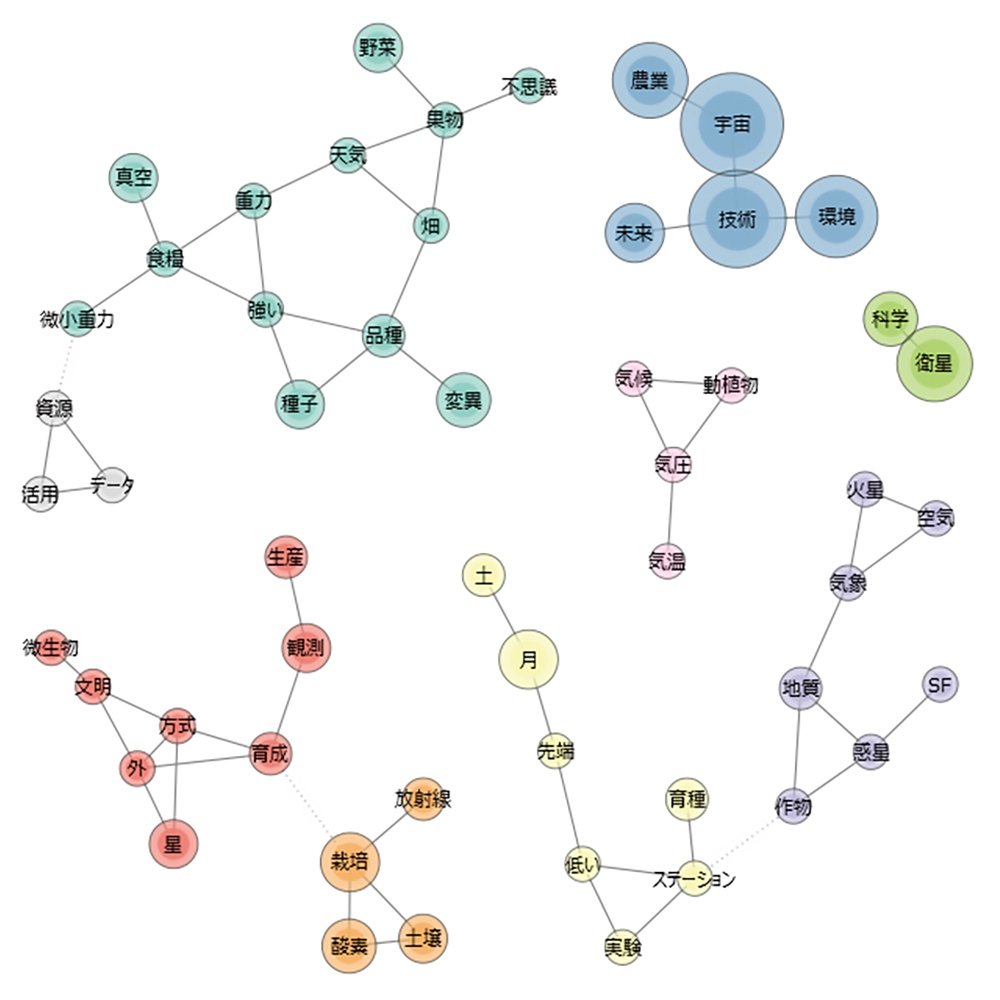 Text Analysis of the Text Entered into “digital Mandala”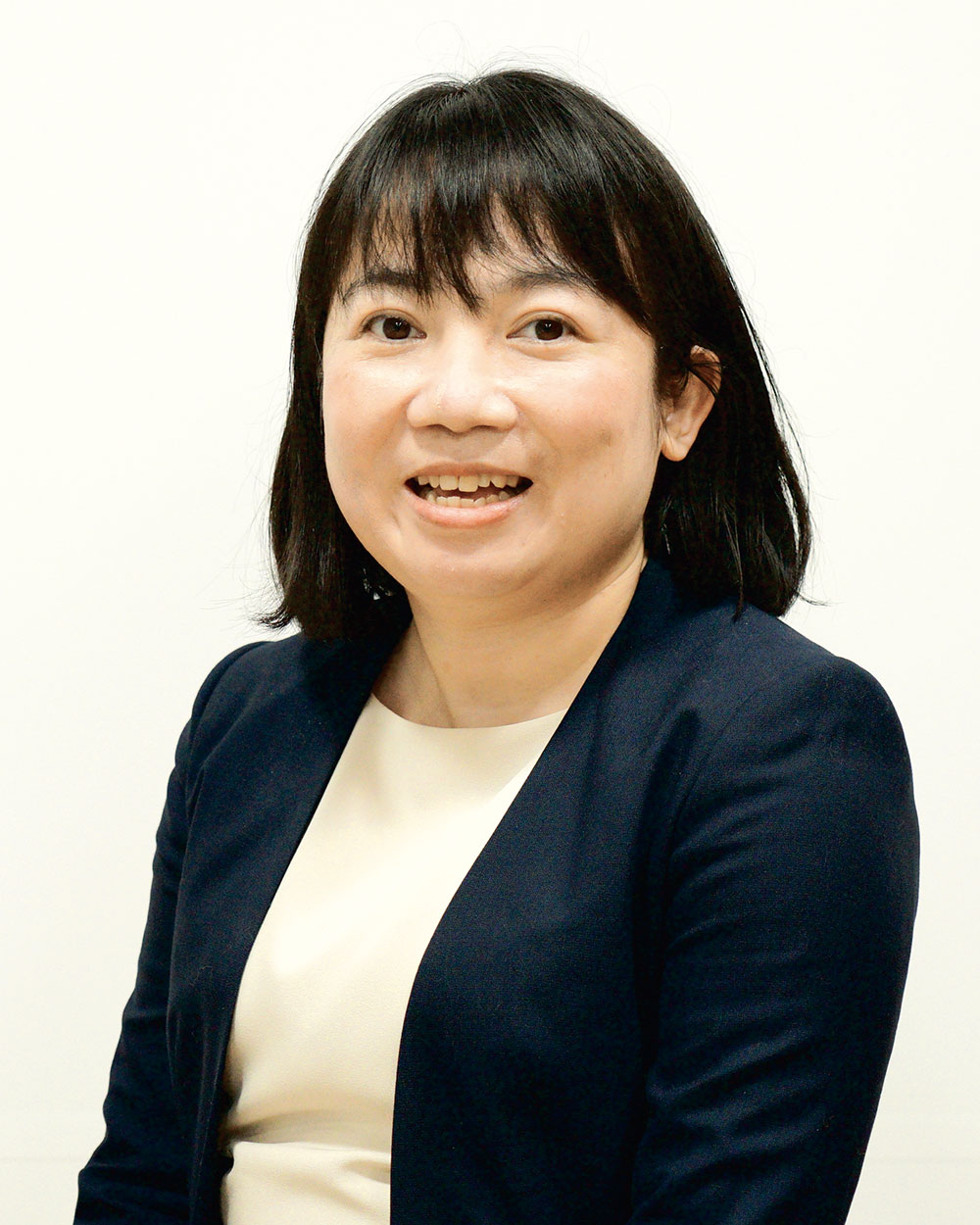
Miki Ueno, Lecturer
I focus on how to build relationships that allow people to perceive a sense of mind in AI, and I conduct research and teach courses that combine artificial intelligence with creative work.To date, I have conducted engineering research into how people understand and create stories and characters.In particular, our research on understanding the plots of four-panel comics was selected as a national project under JST ACT-I, and we have presented our findings both in Japan and abroad.As a result of this research, I have also become involved in organizing international workshops.We are currently proposing the “Mikasa Project,” a research initiative focused on AI capable of interactive voice dialogue using generative AI.
Drawing inspiration from Japan’s “oshi culture,” we are researching methods to design AI that people can naturally relate to and maintain long-term relationships with by pre-determining the AI’s personality and perspective.These efforts have been publicized internationally, and I have also given invited lectures at research institutes and other organizations.In my classes and seminars, I teach two specialized fields: “IT Manga and Anime” and “Artificial Intelligence,” and I also lead exercises where students design their own character AIs and bring them to life.人工知能学会全国大会に何度も学生を送り出し,研究発表の指導にも力を入れています。I myself love creating things, and I work on a variety of projects across different fields, including apps, images, novels, and games.Please be sure to tell us about the things you “enjoy” and the things you’d “like to make.”
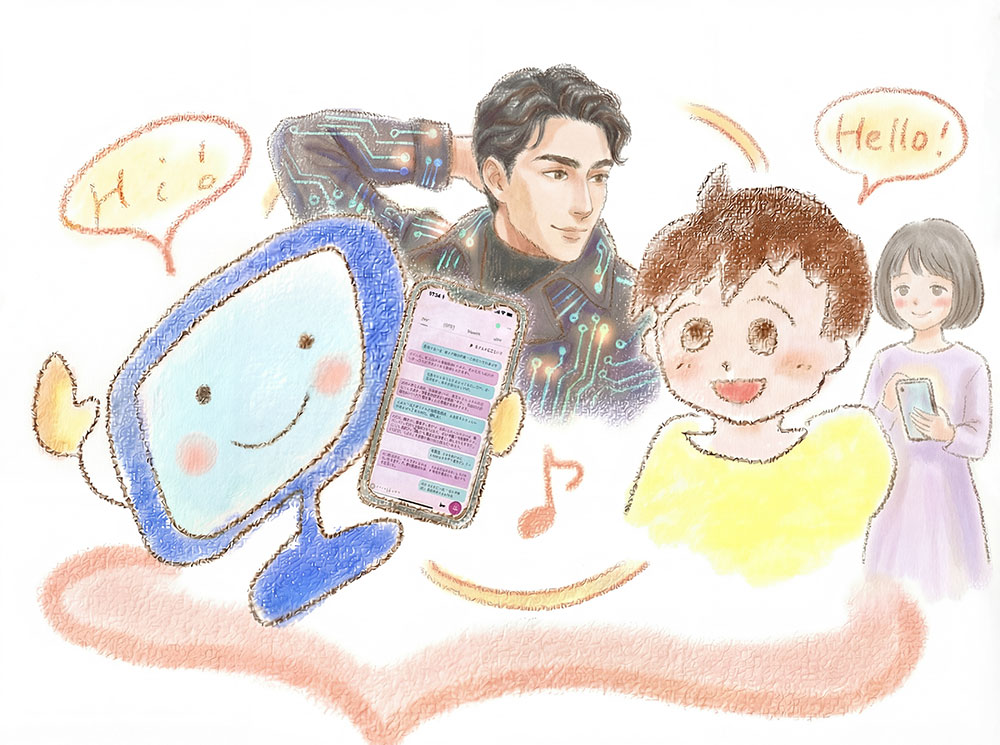
The image below shows a drawing I created with a graphics tablet during my undergraduate years—which served as the inspiration for my research—with a smartphone running the Mikasa voice-enabled chat app I recently developed superimposed on top of it.Can you tell which parts are me and which parts were drawn by AI?
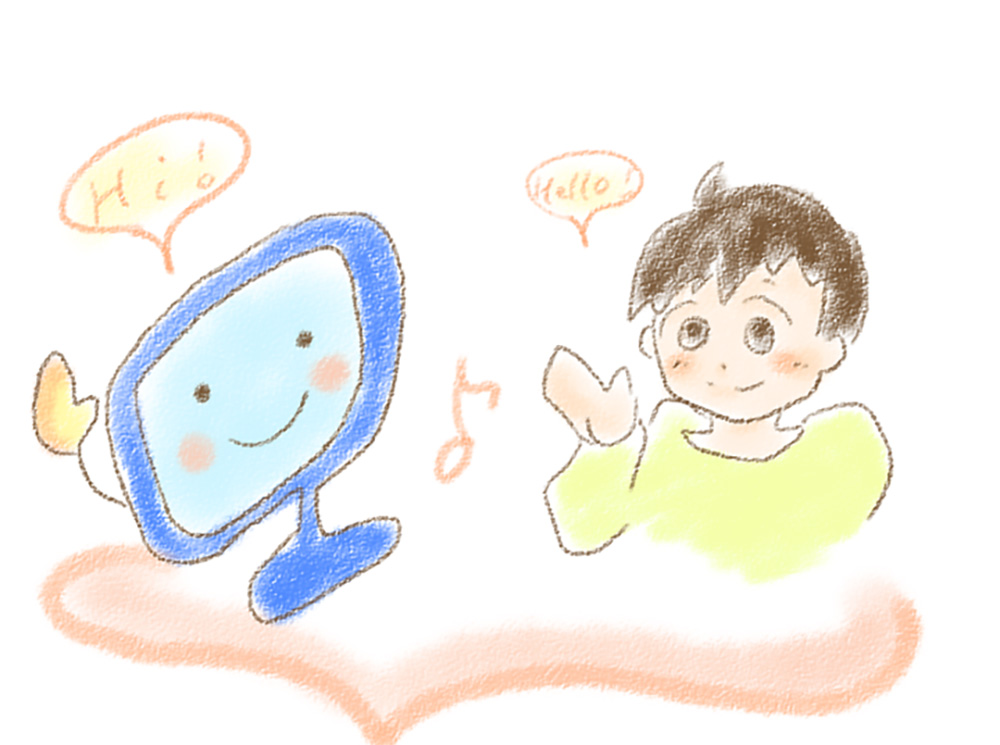 A painting I did during my undergraduate years
“Which part is me, and which part is the AI?”“──A drawing from 16 years ago and today’s generative technology”
Based on this single illustration I drew during my undergraduate years, I collaborated with current generative AI to complete the artwork for a printed pamphlet.Although they may appear to flow naturally into one another at first glance, this painting actually encompasses a 16-year gap in both time and technique.
“Which parts were done by hand, and which parts were done by AI?”is by no means irrelevant to contemporary creative work.Image-generation technology is becoming a tool that works in harmony with past memories and sensibilities to expand individual expression.
Image-generation technology is becoming a tool that works in harmony with past memories and sensibilities to expand individual expression.The evolution of generative AI not only expands the range of “things it can do,” but also gives new form to “what it wants to express.”
I hope this artwork inspires you to imagine the future of creative collaboration with AI.
“How Much Should We Let AI Handle?”— Building the Best Possible Relationship with AI
Actually, 99.9% of the text in Column 2 above %AIwas written by AI.That conversational AI is a character I created named Mikasa, and it knows all about my research and creative work.Naturally, they help me expand on my ideas while fully understanding the principles that are important to me.
Have any of you ever used AI to help with your homework?
Let's Make Writing Book Reports a Breeze!It’s an era where, once you set your mind to it, things can be done easily.From an educational standpoint, there are certain skills that can only be truly mastered by working through trial and error on your own until you complete the task.
So, I really don't want you to ever stop thinking for yourself.On the other hand, AI may offer objective perspectives that you never would have thought of, and you may learn something from them.That’s why I don’t tell graduate students, “Don’t use AI.”I hope you'll make good use of it.
I’m enjoying living in an era where I can collaborate with AI that truly understands my thoughts.On the other hand, I am concerned about the reality that some people become too dependent and end up losing their strength.At the very least, what do I value, and what do I want others to know about me?I want to contribute to building a society where we selectively communicate this to AI, turning our personal AI into the best possible partner, and where this, in turn, broadens the scope of human intellectual exploration and creative expression.
Finally, I wrote this text 100% on my own.Do you understand the difference?
──So, how would you use it?