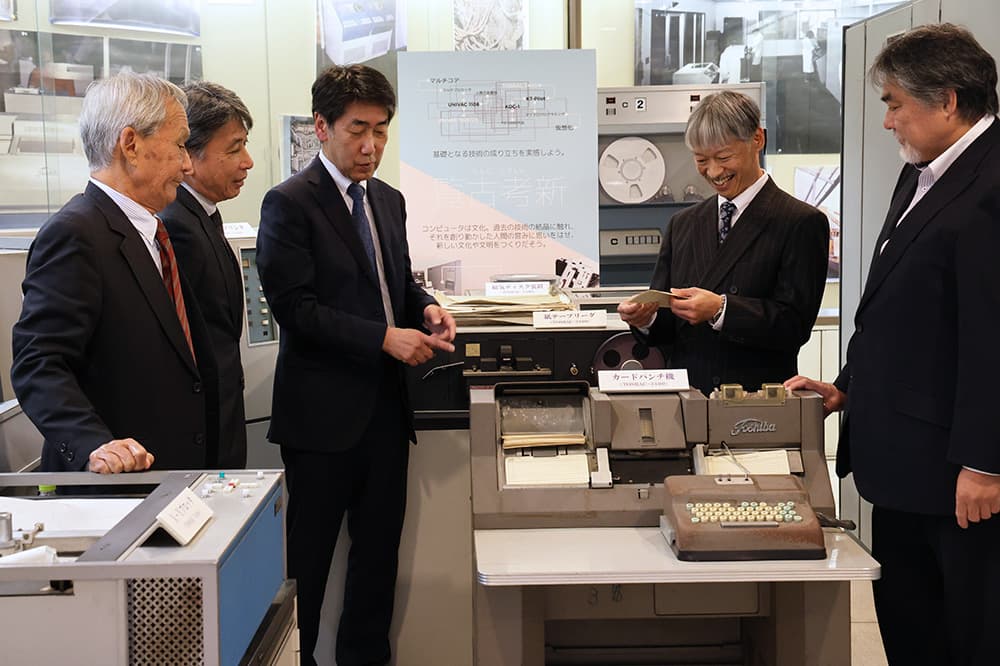
The "Future Environment Lab" jointly established by The University of Informatics Educational Corporation, The Kyoto College of Graduate Studies for Informatics (KCGI) and Kyoto Computer Gakuin (KCG) and BIPROGY Corporation, a major IT service provider, is working on the "Ranko Koshin Project" using many valuable past masterpieces preserved by KCG as subjects to look back on computer history and to hand down a record of ever-changing technology to the future.This "Ranko Koshin Project" was featured in BIPROGY's digital media "BIPROGY TERASU".
In the article, key members of the project discuss their roles, the history of the project, and their vision for the future.KCG views computers as "culture" and has preserved the equipment used by students for practical training as a computer museum since its establishment.One milestone was the effort to light the maintenance panel of the UNIVAC 1100/20, which has close ties to BIPROGY, just as it was then.In the future, we plan to open to the public as a digital archive, including many devices and materials that are still in storage due to space limitations.
The Future Environment Lab, together with the students of the KCG Group, is trying to think about the future, not just looking into the future, but also taking into account technological advances.
The KCG Computer Museum preserves and exhibits computers and other equipment used in education, training, and research over the past 60 years since the founding of KCG, the first computer education institution in Japan.There are seven models of "Information Processing Technology Heritage" including "TOSBAC-3400" and "OKITAC-4300C System," and many other valuable machines from the past are on display, attracting many visitors as a place where they can get up close and personal with the technology that supported Japan's rapid economic growth.
BIPROGY TERASU
"Ranko Koshin Project" Connecting the Memory of Computers Away from the Surface to the Future
https://terasu.biprogy.com/article/kcg-digitalarchive/