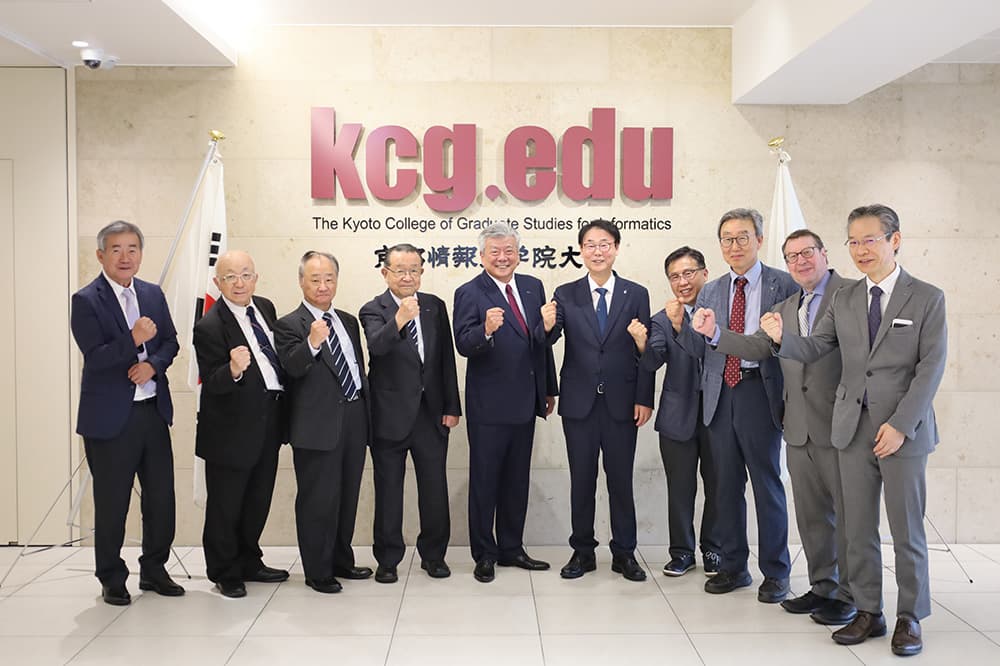
On July 22, 2026, The Kyoto College of Graduate Studies for Informatics (KCGI), part of UOI - THE UNIVERSITY OF INFORMATICS, signed an agreement with the Glocal Project Group at Jeju National University in South Korea regarding a “Locationation (educational tourism)” program.In March 2025, KCGI signed a “Experiential Learning Agreement” with Jeju Special Self-Governing Province and Jeju National University to implement a study abroad program.On this occasion, Jeju National University was selected as a “Glocal University” by the South Korean Ministry of Education, and the Jeju National University Glocal Project Group will take the lead in implementing the five-year “Jeju Glocal University Project.” Accordingly, a new agreement has been signed.The signing ceremony, held at the KCGI Kyoto Main Campus in Hyakumanben, was attended on behalf of KCGI by Wataru Hasegawa, Rector of KCGI, Kyoto Computer Gakuin (KCG), and Kyoto Computer Gakuin Automobile School(KCGM), Yoichi Terashita, President of KCGI, along with other representatives from the KCG Group; and from Jeju National University, President Yang Duk-Soon, who assumed office as the 12th President in March 2026, and Director Lee Dong-seon of the Business Division. President Terashita and Director Lee signed the MOU.
"Lancation" is a portmanteau of "learning" and "vacation." It is a new educational program that has emerged in recent years, designed to provide opportunities for "experiential learning" through educational trips that combine academic goals with cultural exploration.Jeju Special Self-Governing Province (i.e., Jeju Island) is one of South Korea’s most popular tourist destinations, rich in nature, history, and culture, and attracts many tourists from Japan.At the signing ceremony, President Hasegawa stated, “Our university strongly supports President Yang’s vision of leveraging AI for the advancement of higher education and the local community.”"I am confident that our two schools can join forces in many fields, including AI, tourism, regional industries, online education, and student exchanges," he said in his remarks.President Yang said, “We’ve had a relationship with KCGI for 20 years, and I consider them to be like brothers.”I felt there was much to learn from the vision of KCG’s founding couple, who looked toward the future of IT, and from President Hasegawa’s philosophy of further expanding KCGI."I think of President Hasegawa as my older brother, and I hope to deepen our bond as brothers," he replied.During the subsequent meeting, President Yang strongly urged, “Let’s compile a list of areas where our two universities can collaborate, form a joint team, and move forward with them one by one,” and President Hasegawa readily agreed.The two schools have taken a new step toward further strengthening their ties.
Founded in 1952, Jeju National University is a comprehensive university with 13 colleges, 10 graduate schools—including the Graduate School of Medicine and the Graduate School of Law—and numerous affiliated facilities.In 2006, the two sides signed an academic exchange agreement aimed at promoting education and research in the field of ICT, as well as fostering mutual personnel exchanges, and in 2008, they agreed to establish a Japan-Korea Cyber Campus where students from both countries could take courses online.In 2010, the two institutions signed an agreement to operate a dual-degree program that allows students to earn degrees from both institutions while transferring credits.In 2024, the two universities signed an academic exchange agreement aimed at sharing expertise in multilingual education; in March 2025, they signed an “Experiential Learning Agreement” and an “Agreement on the 3+2 Cooperative Education Program between Kyoto University of Information Science and Jeju National University” regarding the dispatch of international students.In February 2024, President Hasegawa was awarded an honorary Doctor of Engineering degree from Jeju National University.