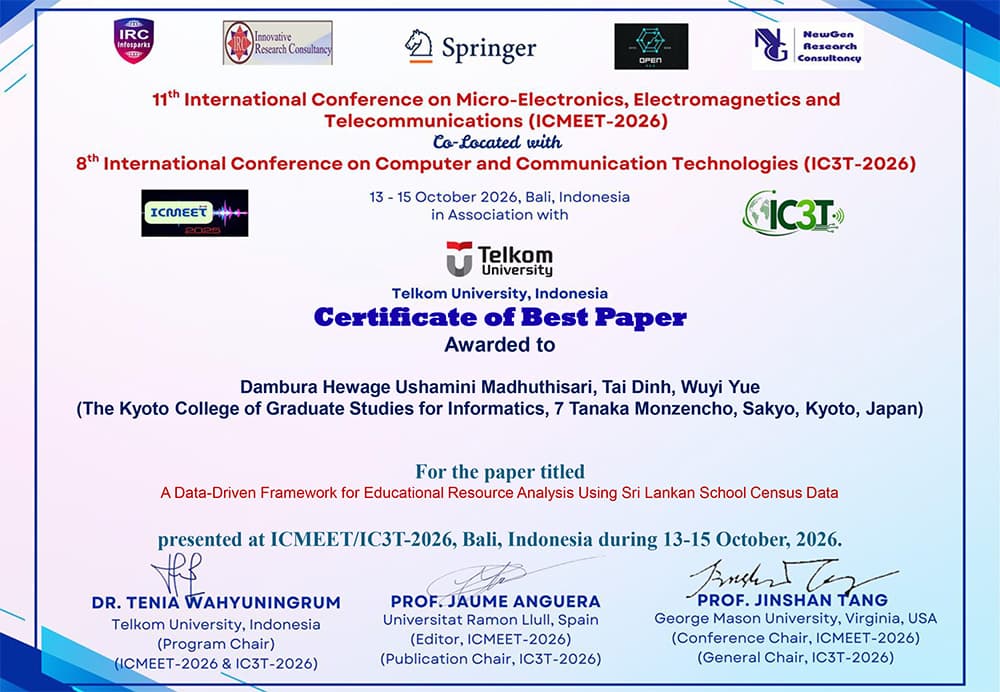
 Certificate for the Best Paper Award from the International Conference on Microelectronics, Electromagnetics, and Telecommunications ">
Madhuthisari, a student at The Kyoto College of Graduate Studies for Informatics (KCGI), part of the Information University Educational Corporation—originally from Sri Lanka—along with her advisor, Associate Professor Dinh Duy Tai, andand Professor Wuyi Yue, was selected for the “Best Paper Award” at the 11th International Conference on Micro-Electronics, Electromagnetics, and Telecommunications: ICMEET2026), held on Bali, Indonesia, from October 13 to 15, 2026.It is scheduled to be published in *Lecture Notes in Electrical Engineering* (LNEE), a book series in the field of electrical engineering published by Springer Nature in Germany.
The award-winning paper is titled “A Data-Driven Framework for Educational Resource Analysis Using Sri Lankan School Census Data.”Using official school statistics from Sri Lanka, we proposed a data-driven framework to analyze the distribution and changes in educational resources across 25 districts nationwide from 2021 to 2025.
The analysis revealed that while the number of elementary and secondary school students nationwide is declining, the number of teachers has increased slightly, resulting in an improvement in the student-to-teacher ratio.On the other hand, we demonstrated that there are significant differences in educational resources across districts and that by combining multiple indicators—such as school size and teacher allocation—it is possible to systematically classify the characteristics of each region.We also examined the feasibility of short-term forecasting regarding the status of educational resources.
A key feature of this study is that it has established an analytical method characterized by transparency and reproducibility, enabling a comprehensive range of analyses—from interregional comparisons and classification of characteristics to predictive assessments—even when detailed data on individual schools are unavailable, using only publicly available official statistics.These findings are expected to contribute to identifying regional disparities in educational resources and to the development of data-driven educational planning and resource allocation strategies.